Casting Blossoms to the Sky and the Long Farewell to Obayashi
 Over the past few months I've been watching the films of Nobuhiko Obayashi. This was prompted by the refrain of various respected cinephiles that his films deepened their relationship with cinema. Thirteen films in I can confirm that they weren't exaggerating - working through this man's filmography has felt like a cinematic bildungsroman.
I'm writing about Casting Blossoms to the Sky because it's the first in the final crop of films Obayashi directed in the 2010s, before he died in 2020, that expressly deals with war and pacifism. Prior to this death Obayashi often explained that his films were about war in some sense, the most striking example being that House was about the guilt he felt over surviving Hiroshima when none of his school friends did (try rewatching it with this in mind). These last four films however are explicit rather than allusive. Arriving here after having watched so much of his prior work feels like a culmination of something significant. I've completed the necessary work to appreciate his grand ambition, his profound examination of war, its causes and its costs. Pair this with a contemporary moment where America and Israel are collaborating in some of the most diabolical acts of mass murder in my life time (truly a tall order) and I was not prepared for the intensity of my response to this film.
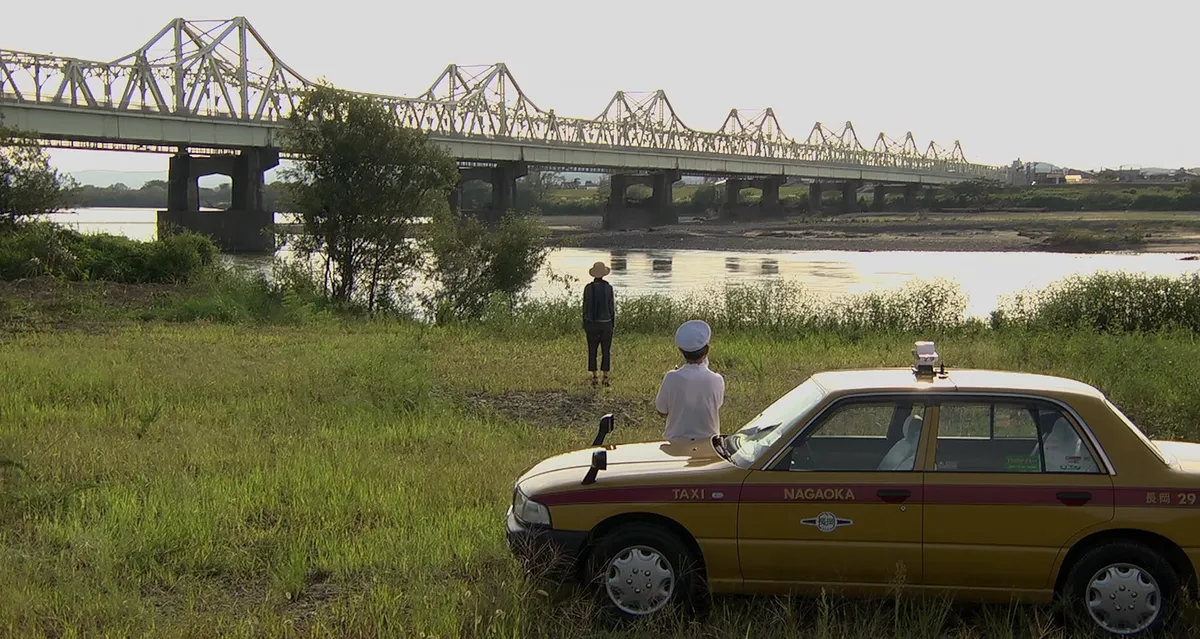
That mix of grief and catharsis might be why I'm struggling how to summarise Casting Blossoms to the Sky. In principle it concerns a journalist called Reiko who interviews survivors (of wars, of occupations, of earthquakes). Her ex-boyfriend from the distant past Kenichi, now a high school teacher, has invited her to his hometown of Nagaoka to watch a play written by mysterious student of his about the WWII air raids that occurred 75 years prior. He thinks she'll have a professional interest in this as well as the town's history, which also includes a major earthquake that happened in 2005.
These are just the contours of the experience. What follows is a film essay (the title card announces) about Nagaoka's people, multiple generations that exist simultaneously, alive or not, and recent and past events that intertwine as the film unfolds. It is a virtuosic fantasia of human experience that rejects linearity in favour for pure sensation; a fireworks display of grief and renewal. I was bewildered and stunned as I watched, disjointed moments forming into something profound, and I haven't felt such raw emotion watching a film in a long time. I was sobbing, asking myself how can we do this to each other as much in response to the film itself as the to world I live in here and now.
Creating space to process these impossible, overwhelming feelings is Obayashi's greatest gift as a filmmaker. It feels sad to be running out of his work, but if his final three are anything approaching Casting Blossoms to the Sky I will be a better, more thoughtful person after watching them.